Minis
A small experience story! Back in 2021-‘22, when I was building Sparta Maps - our ground truth data collection platform - I remember the long conversations and brainstorming for preventing fraudulent activities during field data collection. How do you ensure the field agents actually visit the farm? How do you know how to eliminate marking useless polygons/points? We designed safeguards, we debated thresholds, we shipped what we could.
But a product is never truly complete. Tech evolves. People evolve. And so do the ways people game the system.
Fast forward to early 2026. We had 18,000+ polygon markings from two vendors across India, and something felt off. My data team complained about the data quality. So I did what any PM should do - I went back to first principles.
What does genuine field data collection actually look like?
A person walks to a farm. They stand near the edge. They draw the polygon. They fill the form. They take a photo and submit. It takes time. It takes movement.
So I worked with AI to build a 5-layer fraud detection pipeline:
- Is the agent’s GPS more than ‘X’ m from the polygon?
- Are multiple distant farms being marked from the same fixed location?
- Is the implied travel speed between submissions physically possible?
- Is the GPS placed deep inside the polygon rather than at the edge?
- Are 5+ submissions happening within 5 minutes - burst clustering?
The results were stark !
Vendor 1: 96.5% of 10,984 markings flagged. Travel speeds of 6.6 million km/h detected. One agent submitted 152 markings in 108 minutes across two districts - 43 seconds per farm, including travel.
Vendor 2: 69.6% of 7,849 markings flagged. More nuanced - some agents showed clustering patterns consistent with genuinely neighbouring farms, not fabrication. That distinction matters. .
We also ran a perceptual hash (pHash) comparison across field photos - checking whether the same image was reused across supposedly different farm visits. No confirmed reuse in the sample, but suspicious similarity patterns worth investigating further.
Here’s the part I want to be honest about:
AI didn’t solve this. The contextual knowledge did! With AI as my analytical engine, fastened the process and increased the speed.
The 5 conditions, in addition to regular checks, were not an AI model’s findings, the domain knowledge drafted it. Knowing that Vendor 2’s burst flags might reflect clustered neighbouring farms rather than fabrication? That’s not something a model figures out. That comes from understanding how smallholder farming works. Knowing that a field agent stands at the edge, not the centre, of their field? That’s an experience of knowing how the field agent behaves when they are paid per point and also understanding the pattern of marking. Knowing which flags to design in the first place? That’s product thinking.
What AI gave me was speed and scale. What I gave the process was context.
For every PM out there - your irreplaceable value isn’t in doing the work faster. It’s in knowing which work matters, and why. That contextual awareness is the moat. Build it. Borrowing my colleagues words if you donot grab the oppurtunity AI can be your biggest threat!
Data privacy and protection is always a comedy in India. Most people are either aware or do not care or both. “What will they do with my data?” is a common question which most of the evangelists gets in return when they try to explain. The increased popularity of Digi Yatra, people finding it convenient and are not concerned on the privacy is one of the latest sign on this.
Recollecting the 2021 event of WhatsApp’s privacy policy change, commenting the data will be shared with their parent company Meta and will be used for the targeted marketing (and what not, they only knows!). WhatsApp have introduced many features ever since them, now it has become much more than a instant messenger. You can do video call, conference call, business, banking, broadcast, read news etc. apart from the primary instant messaging feature. Wonderful indeed! The app had evolved itself a product.
This note is regarding one such small feature of WhatsApp which is irritating people like me who are concerned of privacy wearing a Product Manager Hat who cares the privacy. The WhatsApp Business accounts can sent you marketing messages (can be anything) and spam you, these can be automated and targeted too. This is regarding this feature.
WhatsApp also have a feature enabling you to opt out of these, reply to any business messages with “STOP”, you are removed/unsubscribed from the list. This option is often not utilized or implemented properly giving no respect to the users.
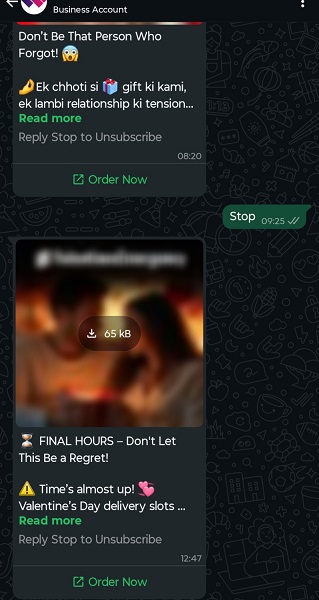
Replying STOP to the messages makes not difference. It keeps sending you the annoying ads.

Some business doesn’t even have the option available. They ignores you and your privacy! Sorry, Its a monologue and you have no options!
Some similar feature is there in the normal text message service (not sure on the name) where business accounts sends you messages (looks different from SMS), but I think the things are better here with a STOP message will make it stop (worked so far, no other experience).
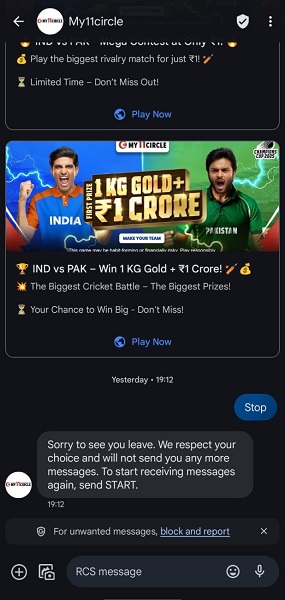
STOP reply worked so far with all such senders.
To WhatsApp
Cant you please develop the STOP feature make it mandate from your end? How much does it take to built this feature? less than a sprint? Make it mandate, non customizable option to all the business messaging accounts, upon receiving a STOP the service should stop sending message to that particular number. This STOP or Unsubscribe feature should not be altered or switched off by any providers using the service. This way WhatsApp can show some respect to the privacy of the users and regain their trust.
To TRAI
The Telecom Regulatory Authority of India (TRAI), should make regulations to protect and respect the privacy of the users. TRAI should make new regulations which stops businesses sending spams to the numbers by default. The regulation should make that all the users will be by default in DND and only those who subscribe for updates can be used for sending these messages not the reverse. The default should be reversed.
Would like to know your thoughts, please comment on Linkedin Post.
Yesterday when I was in the billing queue of a South Indian restaurant in the bus stand, an unexpected error in their billing system caused significant disruption. The restaurant serves its dishes on banana leaves placed over plates, adding a traditional touch and easing cleanup. The billing process is closely tied to the kitchen inventory(or at least I hope so with a fixed count of each dish), ensuring the cashier knows the availability of each dish before billing. The inventory system started showing that banana leaves were out of stock. Since every dish required a plate, and all plates were associated with banana leaves, the entire billing system halted allowing only tea and coffee to be billed. The resturant has a self service system where the customer bills first and then with the physical copy of the bill customers goes to the serving section hands over the portion of the bill to the waiter, who then orders the dish to the kitchen team. In short if “no invoice copy, then no order”. As a result, 7-8 customers left without placing orders because the system couldn’t process any orders. The billing team solved it by adding some additional banana leaves count from their backend inventory system in 10-15min.
The issue stemmed from an unnecessary dependency, tracking the usage of banana leaves as an ingredient. Either the stock entered in the inventory was incorrect, or it became incorrect when the cashier and team had manually adjusted the inventory to resolve the billing issue, highlighting how an over-engineered system or over-accountability can create critical points of failure.
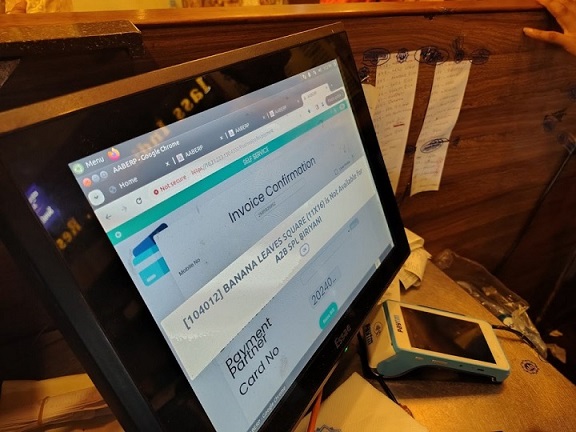
Billing System Screen
What I think went wrong was
- It is totally unnecessary to add banana leaves as an ingredient for every dish.
- It may be an instruction or a need to track the usage of ingredients, but they could avoid banana leaves adding to ingredients as its not a direct/must ingredient.
- The stock of banana leaves entered in the inventory was wrong (or became wrong the cashier and team went and added a new set of banana leaves to it to solve the billing issue). Whatever be the intention or usecase of adding the banana leaves as an ingredient, it caused their sales reduction and manipulated data in the end.
- It is also required to know where to STOP and what not to do when trying to perfect the system and experience.
Lessons for the Product folks
This incident underscores some of my thoughts on Product development and operations listing it below:
- Simplicity is Key: Integrate only essential features without creating unnecessary dependencies that can become bottlenecks later.
- User Experience First: Always prioritize the end user’s experience. A system should enhance, not hinder, customer satisfaction.
- Know When to Stop: It’s crucial to recognize the point at which additional complexity no longer adds value but instead creates potential for disruption.
- Graceful Degradation: Design systems to handle failures gracefully. An alternative billing method could have mitigated the impact.
Let’s strive for smart, simple solutions that enhance efficiency without compromising reliability.